The Myth of the Natural Gesture on Stage
The natural gesture on stage is often carefully shaped. Learn to distinguish a deliberate choice from the audience’s impression of spontaneity.
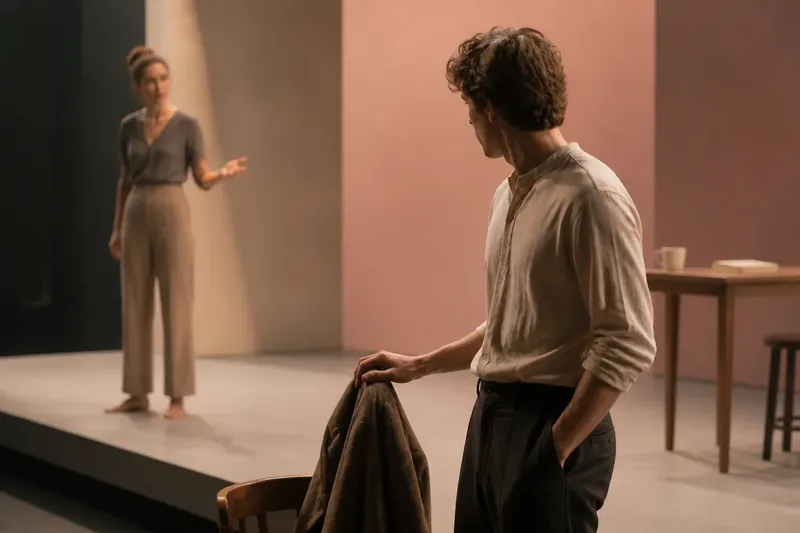
The most common mistake about the natural gesture on stage is to treat an unplanned movement as more truthful than a chosen one. That assumption can cost a performer clarity: an idle hand may draw attention from a line, while a precise movement can make its thought easier to read. The natural gesture on stage is not a movement free of craft. It is a movement that appears to belong to the moment.
Audiences do not see a performer’s private process. They see a body, a voice and a situation arranged in time. A gesture may feel spontaneous because it arrives at the right instant, fits the character’s attention and does not seem to announce itself. Those effects can result from careful rehearsal. They can also be disrupted by an impulse that is sincere but unclear.
Naturalness is an audience impression, not a lack of choice
On stage, an unstudied action still has a shape. The actor turns, reaches, withdraws or keeps still; each option changes the audience’s attention. Even a fidget can become prominent under stage lighting, in a quiet scene or at the back of a room. The body is never merely background.
Deliberate performance choices need not look mechanical. A performer can decide to avoid a character’s gaze, then let the length and texture of that avoidance respond to the scene. The choice provides a playable boundary; within it, the moment can remain alive. This is closer to leaving a door on a well-made hinge than trying to make the door appear untouched.
Spontaneity, in this context, describes an effect. The audience senses that a response belongs to what is happening now, rather than arriving as a repeated display. A fixed gesture can produce that impression if its timing grows from listening and attention. An improvised gesture can fail to produce it if it looks unrelated to the other person or the thought.
Begin a week of rehearsal by noticing the body’s defaults
A short rehearsal routine can separate habit from choice without treating either as a moral failing. Set aside one week of work on a single scene. Keep the task modest: observe how movement functions, then make a few specific choices and test whether they serve the scene. The purpose is not to manufacture a “natural” manner, but to gain control over what the audience is asked to watch.
On the first day, read the scene aloud while standing still. Mark the moments when you want to move, look away, touch an object or change your distance from another performer. Do not correct anything yet. Notice whether the same impulse appears at each run, whether it follows a particular word, or whether it arrives whenever a pause feels uncomfortable.
On the second day, repeat the scene and allow the habitual movements to happen. After each run, name their apparent function in plain language: “I cover the pause,” “I avoid the answer,” or “I try to make the line bigger.” A movement may serve more than one purpose, but naming a likely purpose gives you something usable. It also keeps “that feels natural” from becoming the only note in the room.
On the third day, remove one repeated movement and play the scene without replacing it. If your hand usually reaches for a chair during a difficult line, leave it at your side and attend to the other performer. The stillness may make the line sharper, or it may make the scene feel held back. Either result is information, not a verdict.
Use the middle of the week to compare clear alternatives
On the fourth day, choose one turning point in the scene and rehearse three physical versions. In one, let the body move before the line; in another, move during it; in a third, remain still until the line has landed. Keep the differences legible rather than adding decorative business. Ask a director, scene partner or observer what each version made them attend to.
Say you are playing someone who has just been asked to leave a room. In the first version, you reach for your coat before replying. In the second, you answer and then reach for it. In the third, you hold the other person’s gaze and do not touch the coat. Each action proposes a different relationship to the request; none is automatically more honest. The useful question is which version communicates the character’s immediate aim while leaving room for the scene to change.
On the fifth day, keep the version that best serves the scene and make its practical details repeatable. Decide where the movement begins, what draws your attention towards it and what would stop it. Do not memorise a vague instruction such as “be restless.” A playable note might be “keep the coat in reach, but wait until the other person turns away.” It describes an action and a condition, not a mood to display.
If a stage object is involved, check its placement and use with the director and stage manager. A chair, cup or coat can affect sightlines, timing and another performer’s movement. The relevant details depend on the production’s instructions and the object itself; this is not the place for a surprise flourish.
Let attention make a chosen gesture responsive
On the sixth day, rehearse the chosen movement while listening closely to the other performer. Keep the physical plan, but allow its timing to respond to what is actually heard. If the partner’s line changes the character’s attention, the gesture may begin later or not happen. The action remains deliberate because you know its purpose; it feels present because it is not detached from the exchange.
This distinction matters most in pauses. A silence does not automatically need a gesture to fill it. The performer can stay still while tracking a thought, wait for a sound from the room, or let the partner’s behaviour alter what happens next. A pause can be active without being busy. Audiences are quite capable of noticing that someone is thinking; they do not need a hand to provide subtitles.
On the seventh day, run the scene under ordinary performance conditions. Use the actual spacing, light and props where possible, and play it through without stopping to polish each movement. Afterwards, ask a focused question: “When did you understand what the character wanted?” If an observer mentions a gesture, ask what it made them think or notice. That response is a clue about legibility, not proof that the movement has one fixed meaning.
Keep the choice when rehearsal changes the scene
A movement should not become untouchable simply because it has been repeated. If a new line reading, partner response or blocking change makes it feel misplaced, revisit its timing or remove it. The point of rehearsal is not to preserve the first decision. It is to make the decision clear enough that it can adapt without turning into a collection of nervous habits.
It also helps to distinguish an action from an illustration. Reaching for a glass because the character needs time to answer can alter the scene’s rhythm. Raising the glass merely to show that the character is uneasy may announce a feeling the dialogue already carries. The first action has a practical relation to the moment; the second risks turning the body into a caption.
For performers working without a director, a phone recording can help reveal repeated movements, but treat it as a viewing aid rather than an authority. A camera narrows the audience’s view and may make small actions appear larger or smaller than they do in the room. Review a specific question—such as whether a gesture interrupts the other person’s line—rather than searching for a universal mark of naturalness.
Which rehearsal questions clarify a natural gesture?
Does a gesture have to be spontaneous to feel truthful?
No. It needs to belong to the character’s attention and to the event unfolding on stage. A rehearsed action can feel responsive when the performer remains open to the partner and the moment.
How can I tell a habit from a deliberate choice?
Repeat the scene while removing the movement, then restore it with a clear purpose and condition. If it returns at the same point regardless of what changes, it may be a habit rather than a useful response.
Should I improvise gestures during every performance?
Not as a rule. Some variation can keep a scene responsive, but unplanned business may confuse blocking, interrupt a partner or create a continuity problem. Keep the action within the production’s agreed physical arrangement.
What should I do when stillness feels unnatural?
Stay with a specific task: listen, consider an answer or track a change in the other person. Stillness feels empty when attention has gone slack, not simply because the body has stopped moving.
Choose the gesture that serves the moment
The natural gesture on stage is best treated as a question of fit, not purity. Notice the body’s defaults, compare alternatives, give each chosen action a playable purpose and let attention keep it connected to the scene. A movement that looks effortless may have been carefully shaped; a spontaneous one may still be distracting. The audience needs neither to see the work nor to be denied its result.
When rehearsal ends, keep one useful note about the action: what starts it, what it does and what might change it. That note is small enough to carry into the next performance and specific enough to revise when the scene asks for something else.